
Frequently Asked Questions (FAQ)
Get quick answers to your questions about energy-efficient products like LED bulb types and equivalents, air purifiers, power strips and more.
Click on each question to expand the answer.
Light-emitting diode bulbs (LEDs) offer an energy-efficient alternative to incandescent light bulbs. LEDs use less energy, emit less heat and last longer than traditional incandescent bulbs. LEDs can be used almost anywhere: in recessed fixtures, table lamps, ceiling fixtures, porch lights, vanity bars, chandeliers and more.
Like incandescent bulbs, LEDs also come in different color “temperatures” (e.g. soft white, bright white, daylight). If you want a warm, yellowish light most like an incandescent, choose a bulb with a temperature around 2700K. For cool, whiter task lighting, choose a higher temperature, around 3500K. For crisp, natural light, choose a bulb around 6500K.
According to the EPA’s ENERGY STAR® program, energy-efficient LEDs have several advantages over incandescent lights. LEDs last up to 15 times longer, use up to 90% less energy and emit less heat.
Although LEDs may have a higher purchase price than traditional lighting, each bulb generates up to $55 of long-term savings because they use less energy and have a longer lifespan. When you consider the average home has more than 40 light sockets, the savings can really add up. Instant discounts provided by NIPSCO reduce the purchase price of energy efficient bulbs, making the choice to purchase LEDs even easier.
Finding an ENERGY STAR® certified LED that compares to your current 60W incandescent bulb is easy. Most light bulb packages have “lighting facts” labels, much like nutrition labels on food, to help you find the right replacement bulb. A-type LEDs are versatile, general purpose bulbs and can be used in table lamps, ceiling fixtures, wall fixtures and outdoor porch lights and lamp posts. LED reflectors are a good choice for directional applications, such as recessed cans and track lighting.
Follow these simple steps to find the LED that’s right for you:
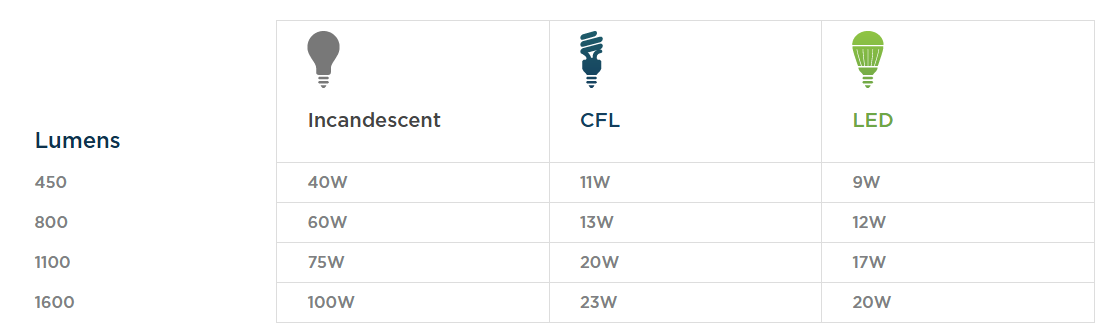
Look for lumens. Lumens are a measure of the bulb’s light output, or brightness. Watts simply tell you how much power the bulb uses. When you purchase a 60-watt incandescent bulb, you are getting about 800 lumens of light. A 12-watt LED produces the same light output from much less power.
Determine estimated yearly energy cost. The label will estimate the bulb’s annual energy cost. Choose a bulb with the lowest estimated energy costs per year. Choose light appearance. The label lists other features, like light appearance, which is measured in Kelvin (K) and described as “soft white” or “daylight.” Lower numbers are softer and good for living rooms and bedrooms. Higher numbers are crisp and white and good for kitchens, bathrooms and reading lamps.
Is it important to buy an ENERGY STAR® certified bulb? ENERGY STAR® certified products have been tested to meet performance criteria established by the EPA and DOE for minimum lifetime and efficacy requirements, and maximum allowed product start and warm-up times.
Manufacturers are required to label the product if the light output is different than that of a soft white incandescent. If you choose a bulb that is not ENERGY STAR® certified, you might not get the performance you are looking for.
ENERGY STAR® certified products have been tested to meet performance criteria established by the EPA and DOE for minimum lifetime and efficacy requirements, and maximum allowed product start and warm-up times.
Manufacturers are required to label the product if the light output is different than that of a soft white incandescent. If you choose a bulb that is not ENERGY STAR® certified, you might not get the performance you are looking for.
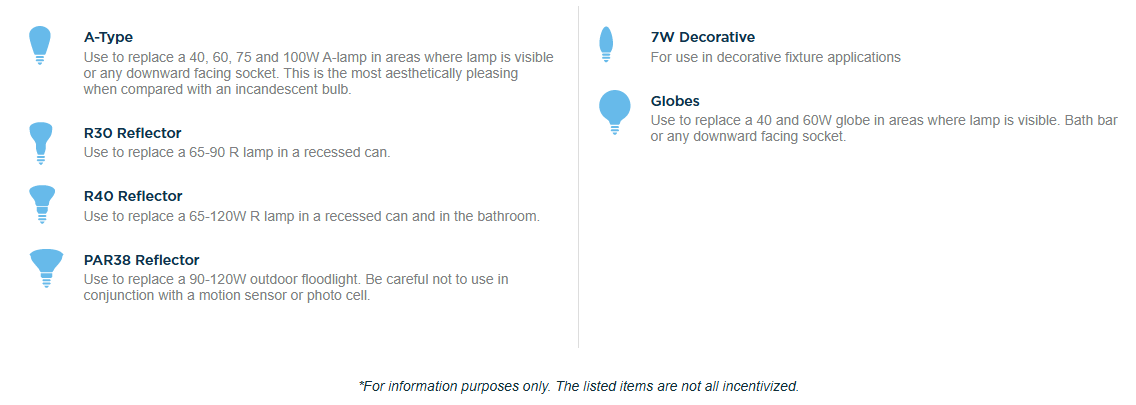
You can find an ENERGY STAR® certified LED designed for use in most of your home’s fixtures. Product types include:
A-shaped and globe bulbs – both are good in almost any fixture. Because they more closely resemble an incandescent bulb, they are good in fixtures where the bulb is exposed, or in fixtures with clamp lamp shades.
R, BR or PAR Reflectors – intended for track lighting and recessed cans, and some weather-protected outdoor spotlights.
Candle shapes – for use in some porch lights, in wall sconces and in some chandeliers. Check the packaging, which will indicate if the bulb can be used in 3-way or dimmable fixtures. Using a bulb that is not intended for use in these fixtures can shorten the bulb’s lifetime.
- Use up to 90% less energy and produce up to 90% less heat than traditional models using incandescent light bulbs.
- Distributes light more efficiently and effectively with custom design around the efficient light source to get the best performance.
- Come in hundreds of decorative styles including portable fixtures such as table, desk and floor lamps and hard-wired options such as front porch, dining room, kitchen ceiling and under-cabinet, hallway ceiling and wall, bathroom vanity fixtures and more.
- Deliver convenient features such as dimming on some indoor models and automatic daylight shut-off and motion sensors on outdoor models.
- Last up to 15 times longer and come with a manufacturer-back warranty of at least three years.
CFLs contain a small amount of mercury, so the EPA recommends that consumers take advantage of local recycling options for CFLs, where available. Most locations of Lowe’s and The Home Depot offer free CFL recycling in their stores, or contact your local municipal recycling facility. Visit our CFL Recycling page to find a list of retailers that offer CFL Recycling near you.
LEDs do not contain mercury and therefore may be disposed of in the trash. However, because these bulbs can last up to 15 years, there will be far fewer used bulbs in our landfills.
- Control outlet (example TV’s)
- Controlled Outlets accessory devices (example gaming consoles)
- Always on outlets (devices that require constant power)